
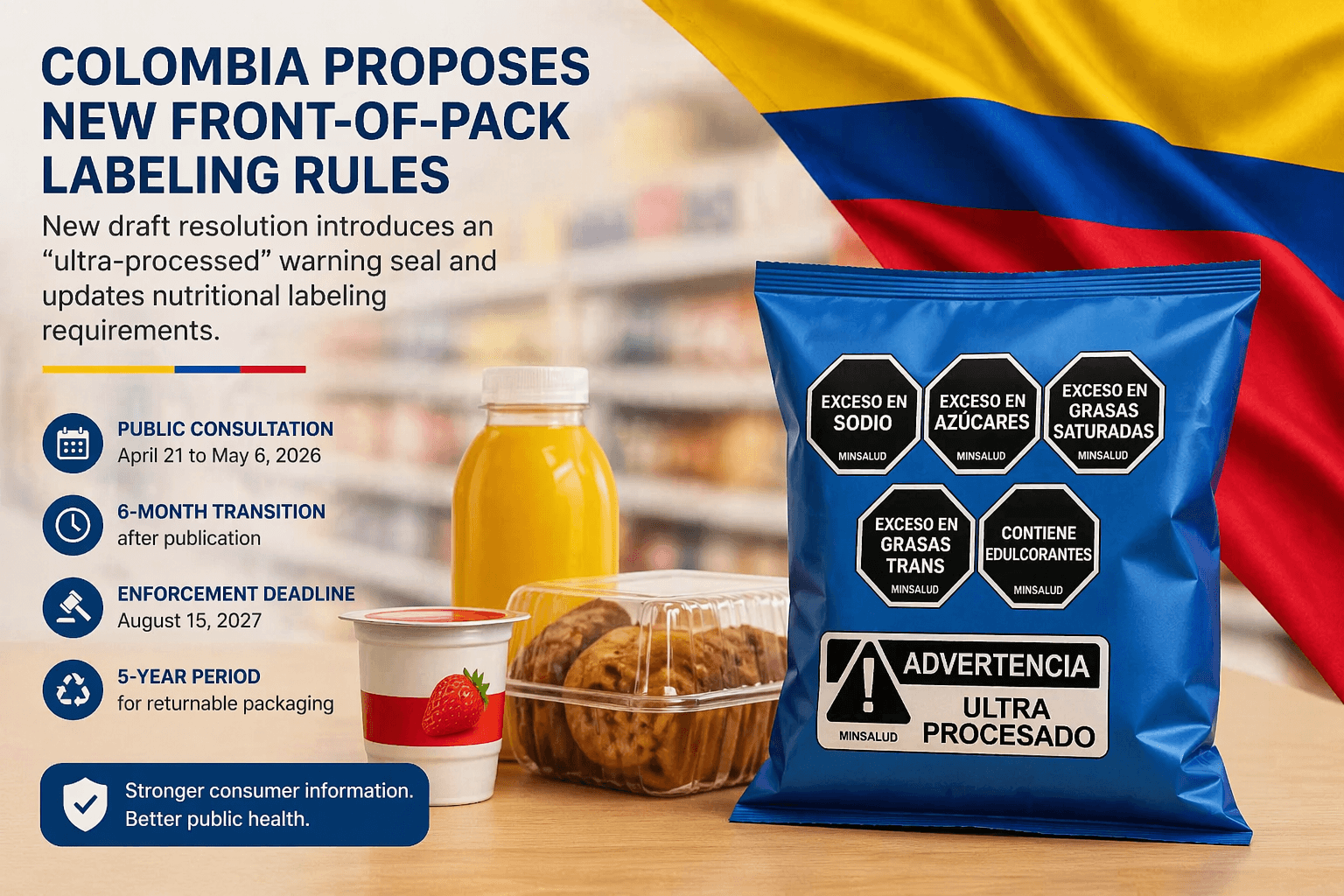
On April 21, 2026, Colombia?s Ministry of Health and Social Protection opened a public consultation on a draft resolution that would overhaul the country?s front-of-pack labeling framework by repealing Resolution 810 of 2021 and its subsequent amendments. The consultation, open until May 6, 2026, marks the beginning of a new regulatory cycle aimed at strengthening consumer information and addressing gaps identified during the first years of implementation of the current labeling system.
The proposal consolidates the existing regulatory framework into a single technical regulation and introduces substantive changes to the way food products are labeled. While it maintains the current octagonal warning seals for nutrients of concern such as sugars, sodium, and saturated fats, it adds a new layer of information through an ?ultra-processed? warning seal and introduces microscale labeling requirements for small packaging formats (see image below). These changes reflect a shift from nutrient-based warnings toward a broader approach that also considers the level of industrial processing as a public health risk factor.

This regulatory update comes at a critical moment. Colombia?s current front-of-pack labeling system, established under Resolution 810 of 2021 and modified in 2022, has already completed its main implementation phase. The regulation became fully enforceable in 2023, and products in the market are now required to comply with the labeling requirements or face withdrawal. Since then, authorities have strengthened surveillance and enforcement, signaling a transition from implementation to strict compliance monitoring.
In practice, this means that the Colombian market has already undergone a significant transformation. Most packaged foods now display warning labels indicating excess levels of critical nutrients, and companies have invested heavily in redesigning packaging, reformulating products, and adapting supply chains. The system has also influenced consumer behavior by making nutritional risks more visible at the point of purchase.
Against this backdrop, the new draft regulation represents not just a technical update, but a second-generation reform. It seeks to correct operational challenges identified in the current framework, such as inconsistencies in nutritional tables, limitations for small packaging, and the absence of a clear indicator for ultra-processed foods, while reinforcing the public health objective of reducing diet-related diseases.
A key element of the proposal is the definition of clear implementation timelines. Once the resolution is officially published, companies will have a six-month transition period to comply with the new requirements. Early adoption is permitted, allowing companies to adjust ahead of the deadline. However, the regulation establishes a firm enforcement milestone. By August 15, 2027, all non-compliant products must be removed from the market, regardless of their production date. Additional flexibility is provided for returnable packaging, which will have a longer adjustment period of up to five years, although interim labeling measures will still apply.
The expected impact on the food industry is significant. First, companies will face new compliance costs, including redesign of packaging to incorporate additional warning elements and adjustments to meet stricter technical specifications. Second, the introduction of an ?ultra-processed? label could trigger reputational and commercial pressures, as products previously compliant with nutrient thresholds may still be flagged due to their level of processing. This may accelerate product reformulation strategies, particularly among large manufacturers seeking to avoid negative labeling.
Third, the reform could deepen market segmentation. Companies with the capacity to innovate, by developing minimally processed or reformulated products, may gain competitive advantages, while smaller players could face greater challenges adapting within tight timelines, despite regulatory provisions that reference differentiated treatment for entrepreneurs.
Finally, the proposal reinforces a broader regional and global trend toward stricter food labeling policies. By integrating both nutrient-based warnings and processing-level indicators, Colombia positions itself among the more advanced regulatory regimes in Latin America, potentially influencing trade, imports, and regional harmonization efforts.
The draft remains under consultation and may still evolve based on stakeholder feedback. However, given the trajectory of implementation since 2021 and the government?s strong public health rationale, the direction of policy is clear. Colombia is moving toward a more stringent, comprehensive, and behavior-oriented food labeling system that will continue to reshape both the market and consumer choices in the years ahead.
Published: April 21, 2026
© All rights reserved. All news and diagrams placed on this Web site is made for internal use. Its reproduction or distribution in any form are welcome in case of placing a direct hyperlink to a source. Reproduction or distribution of information which contains FJS International Solutions® as a source is prohibited without the written permission from the FJS International Solutions®. Photos placed on this site are taken from open sources only or purchased.