

In an environment where information moves faster than ever, the speed at which regulatory developments are reported has outpaced many organisations? ability to verify their accuracy before acting. As a result, misinterpreted updates, preliminary information presented as final, and reports lacking adequate traceability can lead to poor decisions, unnecessary alarm, and significant business costs.
The Risk Is Not Only Fake News, but Insufficiently Validated Information
Misinformation in regulatory affairs is not limited to fake news. It also includes:
- Preliminary information presented as definitive
- Technical alerts communicated before full validation
- Publications lacking a verifiable primary source
- Incorrect interpretations of regulatory developments
- Communications with insufficient traceability or ambiguous attribution
In each case, the consequence may be the same: business decisions made on the basis of inaccurate or incomplete information.
When Repetition Turns Errors into ?Facts?
Recently, news of the alleged approval of front-of-pack labelling regulations in Jamaica was widely shared across the regulatory community despite the proposal remaining in draft form and still under discussion with the Jamaica Ministry of Industry, Investment and Commerce and other stakeholders.
Direct validation with the relevant authority confirmed that no approval had been granted. By that point, however, the information had already been repeated multiple times as if it were confirmed fact.

Fake news caption circulated about the approval of FOP labelling in Jamaica.
Even Without Fake News, Lack of Validation Can Escalate Rapidly
Not all incorrect information stems from deliberate misinformation. In 2013, an alert regarding suspected Clostridium botulinum contamination in ingredients used in infant formula in New Zealand triggered global product recalls and trade restrictions before it was confirmed that the detected bacteria was not the organism responsible for botulism.
The case demonstrated that insufficient technical validation alone can generate major regulatory, commercial, and reputational consequences.
Traceability Is Also Part of Verification
Verification is not limited to determining whether information is true or false. It also requires clarity regarding the source, origin, and official status of the information being communicated.
This becomes particularly relevant when information derives from internal communications issued by authorities but not published publicly. In such cases, the internal nature of the information and the inability to verify it through public sources should be expressly disclosed.
A recent example in Mexico involved the circulation of an internal instruction from the National Customs Agency of Mexico (ANAM) concerning operational criteria for the release of goods subject to sampling for laboratory analysis. Although the document was ultimately confirmed as authentic through validation with authorities and local customs agents, the absence of official publication created understandable doubts regarding its authenticity until verification was completed.
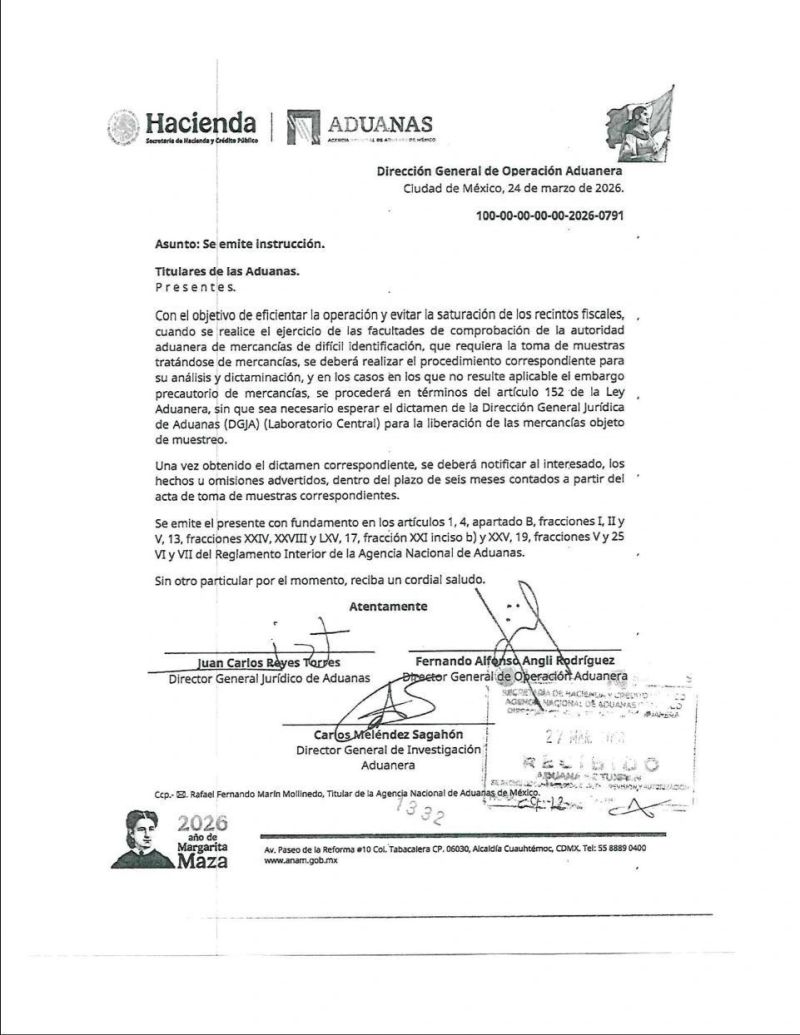
Internal ANAM instruction circulated by customs agents in Mexico.
Why This Matters for Businesses
Acting on incorrect or insufficiently validated regulatory information can result in:
- Misallocation of internal resources
- Unnecessary regulatory adaptations
- Unwarranted internal escalations
- Reputational risk
- Loss of credibility of the regulatory affairs function
The New Standard in Regulatory Affairs: Not Just Monitoring, but Validating
Today, the value of a regulatory affairs team lies not only in identifying developments before others, but in determining:
- What information is official
- What remains preliminary
- What has been confirmed
- What requires further validation
- What has genuine business impact
Speed matters, but in regulatory affairs, accuracy matters more. Before acting on any significant regulatory development, particularly where it does not arise from a publicly verifiable source, organisations should ensure sufficient validation of its accuracy, traceability, and practical applicability, because in regulatory affairs a poor decision based on incorrect information affects more than compliance; it can directly impact a company?s operations, reputation, and financial position.
Note: To present valuable information in a clear and efficient manner, the content below has been organised with the support of artificial intelligence. However, the original concept, selection of examples, content structure, and final version have been supervised, reviewed and validated, by a human regulatory affairs professional.
Published: May 5, 2026
© All rights reserved. All news and diagrams placed on this Web site is made for internal use. Its reproduction or distribution in any form are welcome in case of placing a direct hyperlink to a source. Reproduction or distribution of information which contains FJS International Solutions® as a source is prohibited without the written permission from the FJS International Solutions®. Photos placed on this site are taken from open sources only or purchased.